
The Place We Call Home: Essays and Stories by Sterling Students
Published By Director of Communications and Marketing, Julia Vallera, Featuring Work by Sterling Students in Dr. Carol Dickson’s Nature Writing Course, May 2025
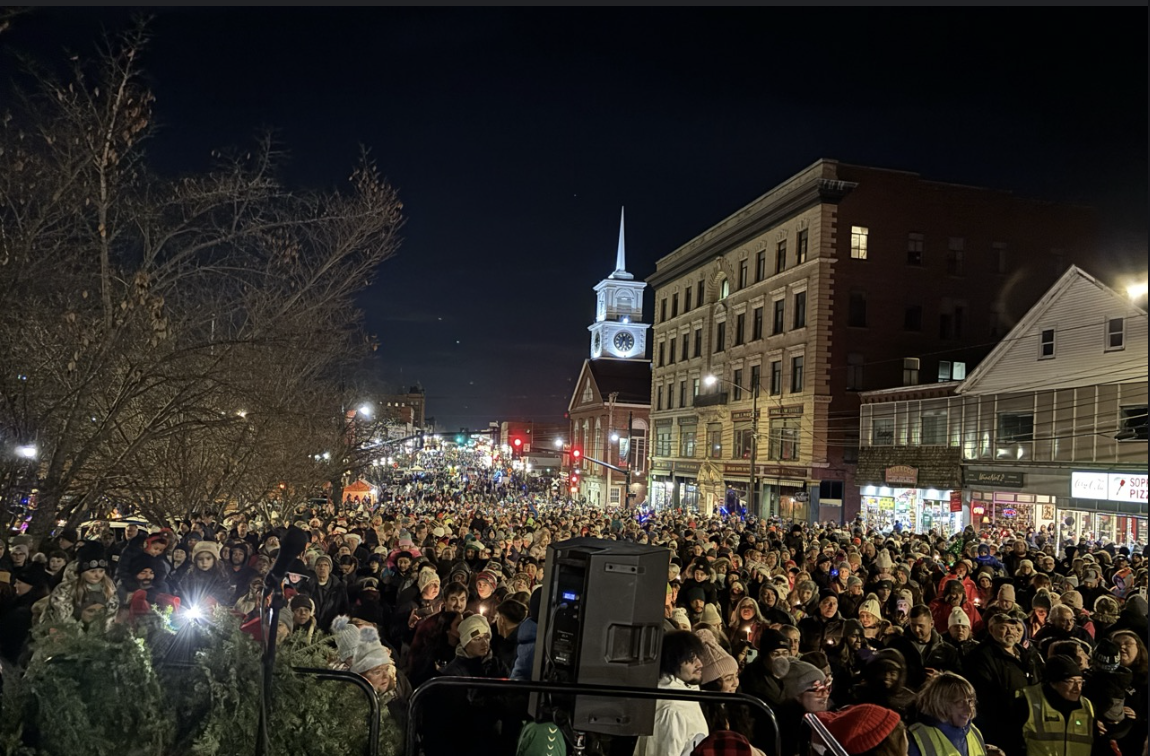
A view of downtown Nashua, NH during the holiday season, from Emma Weldon’s essay. Image credit: Downtown Nashua
This semester, students in Dr. Carol Dickson’s Nature Writing course were given an open-ended assignment:
“Write about a place that is significant to you—one that represents your relationship to where you live, or the place you call home.”
The prompt marked a creative culmination of weeks spent exploring American environmental writing from diverse perspectives. Through intensive study of authors, craft, and the ways language shapes our connection to the more-than-human world, students prepared to tell their own place-based stories.
From Virginia to Colorado, the Hudson Valley to New Hampshire, students submitted nonfiction pieces and creative reflections grounded in the landscapes they come from. Each story offers a personal glimpse into the author’s memories, values, and sense of belonging. Sights, smells, and sounds are captured in vivid detail, invoking nostalgia and an intimacy only possible from lived experience. Fleeting moments are rendered with nuance—only recognizable to someone who has walked that same trail or seen that same light dozens of times.
At Sterling College, we believe learning happens across all aspects of life: Academics, Work, and Community. Every class is grounded in experiential education, field-based practice, and hands-on skill-building that encourages both personal and intellectual growth.
Sterling student Sarah Tutt beautifully reflects this connection between life and learning. Drawing from her childhood in Colorado and her path into Ecology, she writes:
“Here is where my interest in plants began, in wanting to know the names of the flowers who granted respite to the fields of brown and yellow.”
We invite you to read the full essays below and discover how our talented students draw meaning and inspiration from the unique places they call home.
-
I live in Leeland Station, a suburban neighborhood in Fredericksburg. The houses look similar, with rows of lawns in the front and back. Perfectly trimmed, uniform grass that doesn’t have much diversity other than dandelions, henbit, purple dead nettle, clovers, and wild violets. It’s one of the strange contrasts of living here: people plant trees and put up bird feeders, but they also mow down anything that doesn’t fit the image of a perfect lawn. Monoculture yards leave little room for native plants, and many people don’t think twice about what’s growing there as long as it stays green.
Still, plants show up in their quiet ways and the buzzing carpenter bees collect and gather pollen in order to create food, and spread the pollen past the yards and into the wooded areas.
One morning, just before sunrise, I saw a fox walking along the edge of a backyard, near the tree line behind my house. It moved quickly. That moment made me realize how close wildness still is, even in a place that feels so controlled.
There’s a small pond tucked behind part of the neighborhood. It’s easy to miss if you’re not looking for it. The water is dark, but it reflects the sky and trees, and it’s full of life with frogs croaking, birds calling, dragonflies hovering just above the surface.
Not everything around the neighborhood is native to the area around. English ivy and Japanese honeysuckle climb up trees and fences, choking out the native species. Even so, the wildness within the area still shows itself.
-
However many times I’ve descended
the hill down to the Wildwood Conservation Area,
it always feels longer than I remember.
49 acres sandwiched between
affordable housing developments,
train tracks,
and a cemetery by the same name.
In the middle is a field.
In the field is a circular walking path.
Through sun, rain, snow, fog, I have walked this path with Tux.
The hill down isn’t the steepest, but on rainy or snowy days,
leaf litter poses a slick threat.
Tux will weave his way through the hardwood forest,
following smells, rolling in decay, digging for rodents.
Down where the forest path gives way to the field,
hardwood canopy recedes.
Open sky returns.
Sometimes the deers will have made a grassy bed the night previous,
remembrance of the mammal body.
In warmer months the field is a no-go zone for me.
Ticks flock to your ankles like heat-seeking missiles.
Little shiny black and brown pearls.
Deer ticks, dog ticks, take your pick of parasitic arachnids.
I’ve gotten good at spotting them
shimmering through black lab fur,
on ankles, on scalps.
In the colder months when threat of ticks has passed,
I walk Tux around the field’s circle,
sometimes once, twice.
Maybe we start in the Wildwood Cemetery
just South of the conservation area.
Other times we take our chances with the hill and all its leaf litter.
Every few years the field gets brush-hogged.
Blackberry and raspberries canes, poison ivy,
aspens, poplars, taller than me, all reduced to nubs.
Succession begins again.
In the winter mice make tunnels up through the snow,
announcing themselves to the dog with his
nose to the ground, paws in the dirt.
Tux makes a good companion until you can’t find him.
He becomes a forest predator,
only interested in the chase,
impossible to recall.
-
My love of ecology grew from my dog’s love of a lake
Dark blue mountains reaching to clear blue sky, clouds their canopy
Trails made up of loose dirt, stones
Dried up streams carve the landscape, only run consistently in early summer
Yuccas, yarrow, cacti, lambs ear, thistles, penny-cress
Tree growing over time, holding a swing too high up to reach
Pond hiding in a valley surrounded by shrubby trees, filled with cattails
Geese constantly in residence, no longer startled by a bark
Pipes from old construction projects strewn about the grass
Dogs bolting across the land after balls or each other, rough housing in the dirt until they
are covered in it
I am out of breath only a half hour in, my body not used to walking for so long in this
place where driving is the only way to get anywhere
Of course, at this time, I didn’t know that my blood pressure was so low
Suppressed by a long time medication, meant to help but secretly hurting
My body is building up bit by bit every week, until my breath starts to return
The stories that this land holds, so many people coming here to simply talk and walk, so
many friendships started by dogs butt-sniffing greetings.
My dad and I, our relationship so often rocky in those days, pose each other impossible
philosophical questions to each other, just to enjoy each other’s excited voices.
There is a sign in bright red blocky letters “No Entering”, maybe because of the pipe's
dangerous nature or the ecological importance of a water hole in a place that can be
dry for miles.
The order was never enforced and our dog so enjoyed swimming, and there wasn't
anywhere else deep enough for her to be free to paddle around like a beaver.
Here is where my interest in plants began, in wanting to know the names of the flowers
who granted respite to the fields of brown and yellow
In wanting to know what birds my dog enjoyed scaring off in the lake
-
Chartreuse autumn leaves and purple sunsets feel like home to me. People travel from around the country to see the smoldering golds and reds as the leaves begin their dying process. The Shawangunks rise around the valley, and it was in these mountains that I first tasted freedom. Every trail felt like a hidden treasure, waiting to be discovered. The sounds of car horns that I had grown used to in Brooklyn were replaced by the crunch of leaves under hiking boots. The silence and darkness of the woods, once scary to me, made me feel grounded. I started to see the trees and the animals around me. I spent nights in teepees perched on rocky ridges overlooking the quiet town below. The world beneath me felt small. The Hudson Valley holds my memories like a warm blanket, softly wrapped around the parts of me I left behind, the parts of me that hurt. It pulls me back like a vine, gently tugging at my heart.
-
A section of the street is packed with people wearing green, red, white, or other earthy toned winter jackets and warm wool hats from sidewalk to sidewalk. Every year, crowds leave just enough space for others to move. The smell of food cooking drifts from restaurants and food trucks with tables on the sidewalk. Fair trucks selling cotton candy, caramel corn, and fried dough are scattered down the street, trying to get one last sale in before the snow comes in. Sculptors with chainsaws carve ice on a roped off section of the sidewalk with a new theme each year like children’s movies or space. The light crystal-clear sculptures are surrounded by people taking pictures since they will likely be gone by morning from a heat wave. A space reserved for dancing plays a variety of music at each end of the closed off street blends when standing between them.
The Holiday Stroll in Nashua happens every year the Saturday night after Thanksgiving. It is one constant in a changing area. Main Street is lined with restaurants and diners, barber shops, thrift stores, city hall, a bank, a library, a new city community theater, and a bagel shop with odd hours. There used to be a room in the library at the end of the street that showed Christmas trees that were decorated by schools in the area and was popular at the Stroll, but for some unknown reason it stopped one year. I have seen a shoe store with a mural on the inside that I used to go to all the time as a kid be torn down and turned into a community theater. Restaurants closed and the now open spaces were used for neighboring restaurants to expand or a new barber shop to move in before they were torn down. My favorite hot dog place closed and turned into a barbeque restaurant. Even with all this change, the Holiday Stroll continues to happen every year and it has become a tradition for my parents and me.
